Deserts & Forests of The World
More Forests Animals

Bushmaster

Range: Northwestern South America
Diet: Carnivore
Conservation Status: Common
The bushmaster is a type of pit viper and hunts at night. The snake uses heat-sensing pits located near its nose to detect warm-blooded prey. Bushmasters are solitary ambush predators. They position themselves along mammal trails, sometimes for weeks, until prey eventually crosses their path. With a maximum length of about 12 feet, the bushmaster is the largest of all venomous snakes in the western hemisphere.
The bite of the bushmaster is one of the deadliest snake bites in the world with a high mortality rate even with treatment. This snake’s striking speed is so rapid and its venom is produced in such large quantities, that it is able to kill almost anything that crosses its path. However, bushmasters are shy and secretive snakes that generally avoid confrontations.
Green Tree Python

Range: New Guinea, Indonesia, and the northern tip of Australia
Diet: Carnivore
Conservation Status: Common
Green tree pythons live in tropical rainforests, monsoon forests, thickets of bamboo, and forest margins with bushes and shrubs.
They are arboreal and lead a solitary life. Most of their time is spent up in trees coiled around branches. These snakes have a particular way of resting in the branches of trees; they loop a coil or two over the branches in a saddle position and place their head in the middle. They are primarily nocturnal hunters and capture prey by holding onto a branch using their prehensile tail and striking out from an S-shaped position and constricting the prey. Green tree pythons may also hunt their prey on the ground using their labial pits and acute sight.
Emerald Tree Boa
Range: South America
Diet: Carnivore
Conservation Status: Common
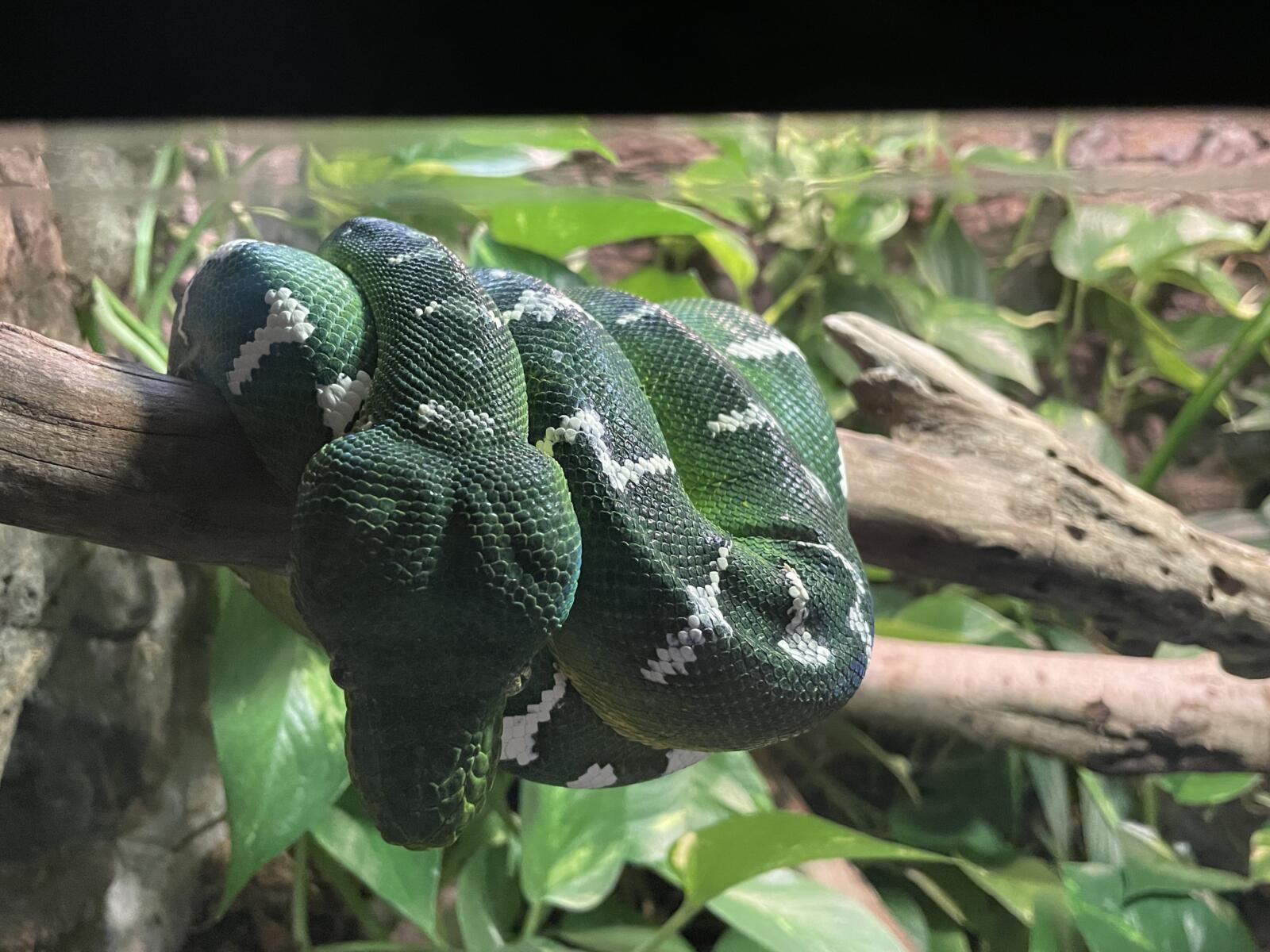
Emerald tree boas are non-venomous, arboreal snakes. They use their prehensile tail to hold onto tree branches. Adults are a bright green color with paler yellow or white bellies, and some have striking white marks along their backs. Adults can grow to over six feet in length. As their name suggests, they are a tree dwelling species, spending most of their time high up in the foliage. They prefer to be solitary. Emerald tree boas are
ovoviviparous, meaning they do not lay eggs like many other snake species, but retain the babies internally and then ‘give birth.’ Unlike mammals, there is no placental connection to the mother. Each juvenile is contained inside its own gelatinous sack.
They are largely nocturnal. In the wild, they spend a great deal of time during the day coiled over a tree branch with their head right at the center. At night, they remain coiled on the branch but will extend their head downward to wait patiently for something to eat.
Eyelash Viper
Range: Southern Mexico through Central America
Diet: Carnivore
Conservation Status: Common
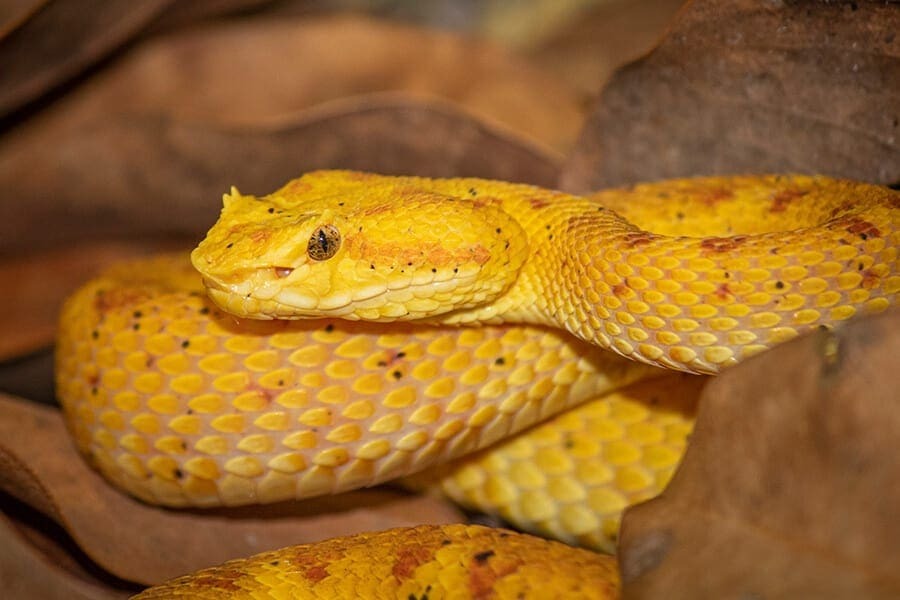
The eyelash viper is named for the bristly scales above its eyes making them look like they have eyelashes over its eyes. Their scales are keeled so they are rough and sharp to the touch. These rough scales may help to protect them against the branches and vines of their arboreal habitat, unlike most snakes whose scales are smooth. It is one of the smallest venomous snakes in Central America measuring only up to 2.5 feet. It is primarily nocturnal with the ability to detect prey by using heat sensitive pits on either side of the head located between the eye and nostril. This is like having a “sixth” sense in detecting prey whose body temperatures are higher or lower than the surrounding environment. It is well camouflaged by flowers and foliage and lays in wait for unsuspecting prey to wander by.
Solomon Island Skink
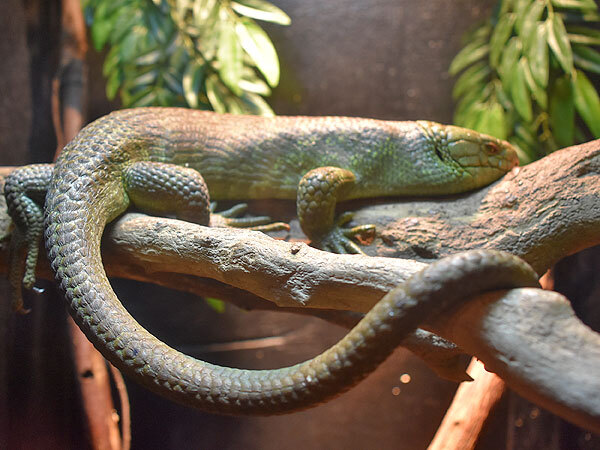
Range: Solomon Island
Diet: Carnivore
Conservation Status: Common
Solomon Island skinks are typically up to 32 inches long with half of that body length being their tail. Their scales can be green but are usually speckled with light-brown or black. They have long, slender bodies and short legs. They are also known as prehensile-tailed skinks or monkey-tailed skinks. They are the largest species of skink and the only known skink species with a prehensile tail. They live in tropical forests and feed primarily at dusk and dawn. They are herbivores eating leaves of a variety of fruits, vegetables, and plants. Habitat loss and extensive logging are serious threats. Wild populations are also threatened by excessive pet trade exports and consumption for food. Export of this species from the Solomon Islands is restricted. They are not listed by the International Union for Conservation of Nature, but it is listed under CITES Appendix II, meaning it is not necessarily threatened with extinction, but its trade must be controlled.
West African Gaboon Viper
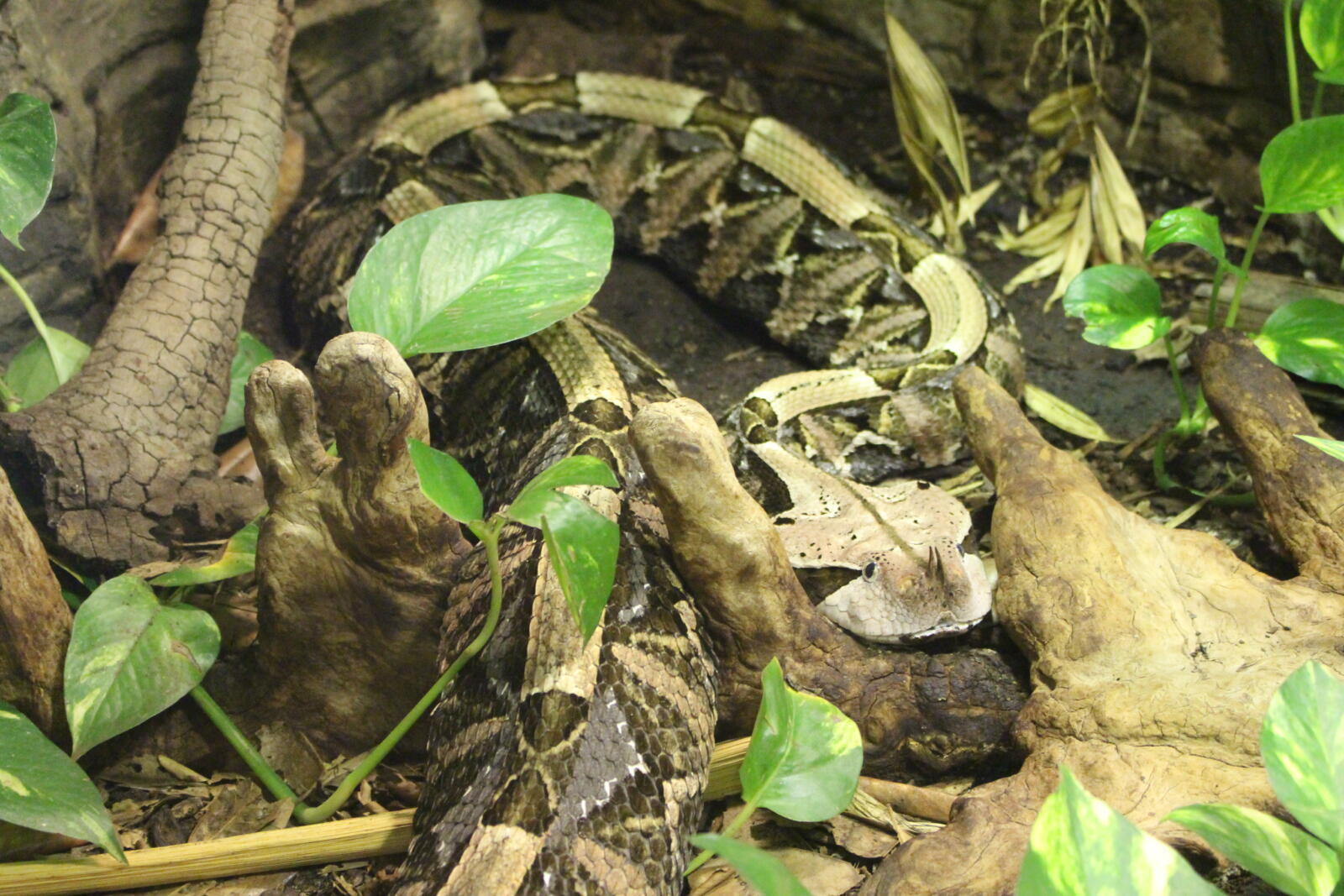
Range: West Africa
Diet: Carnivore
Conservation Status: Common
Gaboon vipers are the largest of the vipers, with an average adult length of about 1.2 meters. They can weigh up 10 kg. They have triangular heads with prominent rostral horns. There is also a very dark line down the center of the head and two dark spots above each side of the jaw. Color patterns on their body form a symmetrical design that makes a unique pattern on the scales.
They are nocturnal, slow-moving, and live in rainforests, moist savannas, and forest edges. They spend time in leaf litter, where they are well camouflaged. At 2 inches long, their viper fangs are the longest of any venomous snake. They use them to inject prey with toxic, immobilizing venom. Although they are venomous, they rarely strike in defense. If they are disturbed, these snakes tend to startle and forcibly exhale air through their nostrils.
Panamanian Golden Frog
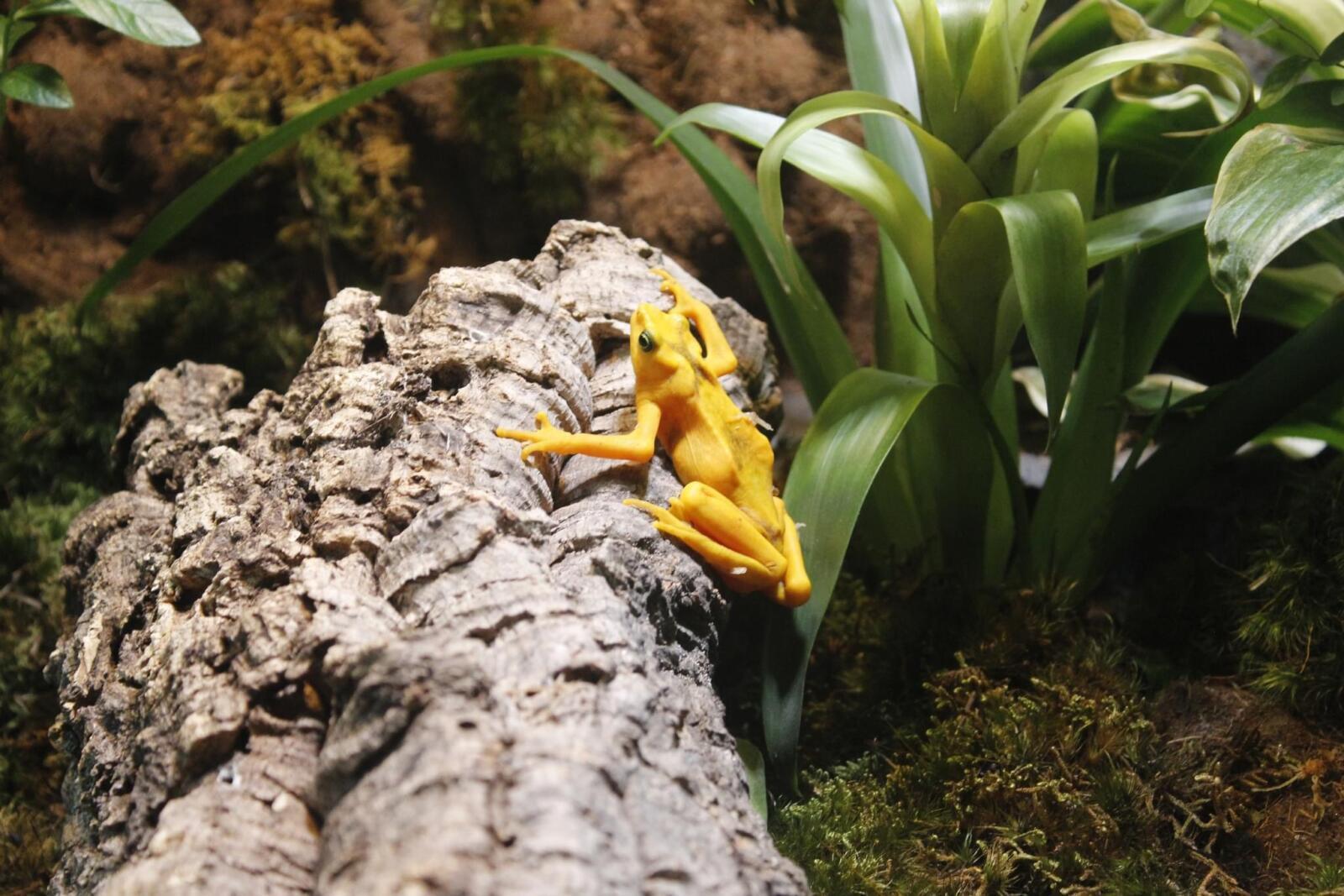
Range: Historically Central Panama. Now extinct in the wild.
Diet: Carnivore
Conservation Status: Critically Endangered
Panamanian golden frogs are native to Panama, where they have been viewed as symbols of good luck for centuries. Unfortunately, an epidemic of chytrid, a fungus highly dangerous to amphibians, has eliminated their populations, and the last one was seen in the wild in 2009. The future of this species is now reliant on the Association of Zoos and Aquariums Species Survival Plan program, a partnership of many zoos and facilities in Panama. Chattanooga Zoo is one of the zoos directly helping this animal from becoming extinct forever.
Dart Frog
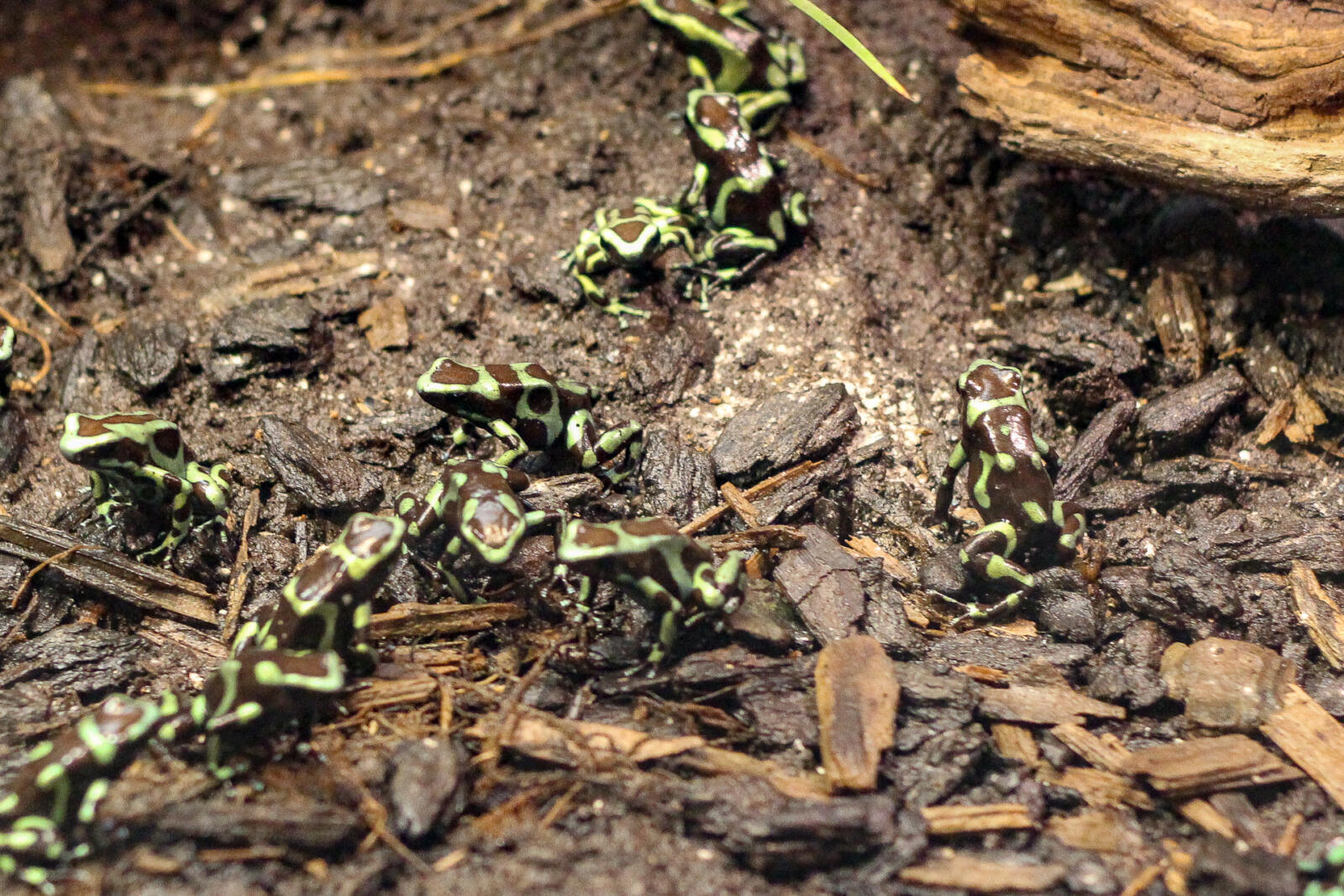
Range: Central and South America
Diet: Carnivore
Conservation Status: Some subspecies are endangered
Dart frogs (also known as poison arrow frogs) are known for their bright colors. Their bright colors warn predators about its toxicity. They primarily eat ants, termites, and other small invertebrates, which they catch easily with their quick, sticky tongues. Unlike most other types of frogs, dart frogs are diurnal, meaning they are active during the day. Poison dart frogs received their name because the Choco people of western Colombia use the poison of the golden poison frog, to coat the tips of the blow darts they use for hunting. The Choco use waxy leaves to pick up the frogs and dip their blow darts in the frogs’ skin secretions. Just a tiny drop can kill the birds and small mammals that the Choco hunt for food. A single golden poison frog, can supply enough poison for 30 to 50 darts, and the dart's poison remains active for up to a year. The poisons in these tiny frogs come from their diet in their rainforest habitats: mostly ants, termites, centipedes, and tiny beetles. This diversity of food items is required to create the chemical toxins by the frog. Specific toxins are passed from each bug to the frog when eaten, which then collect in glands in the frog’s skin. When they are fed a regular zoo diet, the frogs eventually lose most, if not all, of their toxicity.
_____________________________________________________________________________________________________________________________________________________
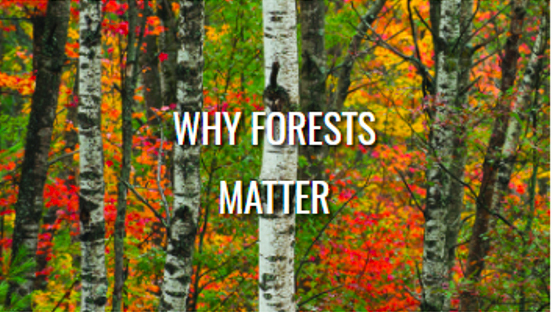
Forests cover around one third of all land on Earth and are important for both environmental health and human well-being.
Have you ever thought about all of the ways we are connected with forests? Whether you drink water, are climate-friendly, care about wildlife, like to get outside and play, care about your community, build houses or fine furniture, we all need forests.
1) People depend on forests to live. They filter the water we drink and the air we breathe. Worldwide, 1.6 billion people rely on forests for their livelihoods, including food, clothing, or shelter.
2) Forests are home to nearly half of the world's animal species, including some of the most endangered birds and mammals, such as orangutans, gorillas, pandas, and northern spotted owls. Deforestation of some tropical forests could lead to the loss of as many as 100 species a day. Our ability to stop biodiversity loss is heavily dependent on our ability to stop forest loss.
3) Deforestation and forest degradation is the second leading cause of carbon pollution, causing 20% of total greenhouse gas emissions.
4) Trees breathe in CO2 and exhale oxygen, storing vast amounts of carbon in the process. From single urban trees to full forested landscapes, trees reduce the heat-trapping layer of CO2 in our atmosphere and clean the air we breathe.
5) Numerous scientific studies show that spending time in forests actually makes us healthier and happier. From boosting your immune system, to lowering blood pressure, to keeping stress hormones at bay.
6) Forests help prevent erosion and enrich and conserve soil, helping to protect communities from landslides and floods and producing the rich topsoil needed to grow plants and crops.